
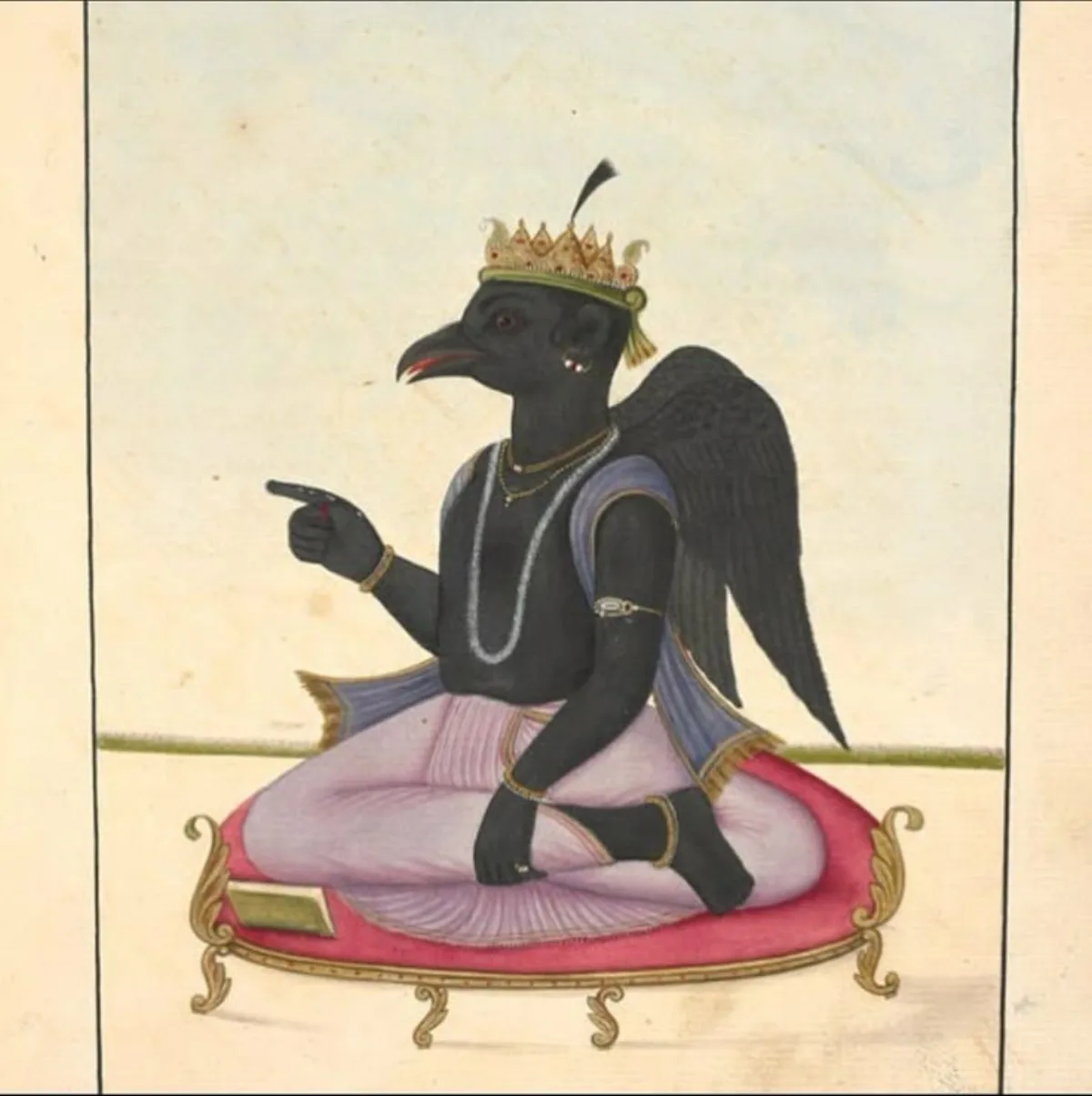
Kakabhushundi is remembered as a crow who has watched worlds rise and pass, a devotee whose long view turns ordinary urgency into one movement within a far greater cycle. That is why his name attracts seekers facing repeated patterns: the same conflict, the same career turn, the same decision returning in a different form.
A Kakabhushundi Nadi reading is often presented as unusually far-seeing or strategic. Sacred longevity, however, should not be turned into a promise of perfect forecasting. The crow-sage narrative offers a lens on time and devotion; the personal-leaf claim still needs an observable matching process and honest boundaries.
Kakabhushundi Nadi astrology—also written Kaka Bhujandar, Kaga Bhusundi or Kaagapujandar Nadi—is a tradition attributed to the crow sage and Rama devotee Kakabhushundi. Modern descriptions emphasize long cycles, repeated karmic patterns, career, enterprise, turning points and spiritual perspective. These are lineage associations, not proof of exact prediction. Verify the collection, matching, translation and cost before accepting a personal leaf.
Who is Kakabhushundi?
Kakabhushundi appears in devotional literature as an extraordinary devotee and narrator of Rama’s story, often represented in crow form. Traditions describe him as witnessing repeated cosmic cycles and speaking from a perspective beyond ordinary lifespan. The narratives vary and belong to sacred literature rather than conventional biography.
Tamil traditions also use spellings such as Kaga Bhujandar or Kaagapujandar and may connect the figure with Siddha memory. These spelling and regional differences should be acknowledged without manufacturing several unrelated sages. The underlying identity is recognised through the crow-sage motif and enduring devotional wisdom.
Why cycles and repeated patterns matter
The crow sage’s long view makes repetition a natural theme. A reading may describe similar obstacles returning in work, money, family or relationships. Such a pattern can be useful if translated into observable behaviour: the same kind of partnership, delayed contract, avoided conversation or untested assumption.
Karma should not become a vague explanation that cannot be questioned. Define the repeating event, the choices made before it and what could be changed this time. A spiritual story about cycles gains practical value when it supports attention and learning rather than fatalism.

Career and enterprise claims need real milestones
Contemporary Kakabhushundi Nadi descriptions often emphasise career, business timing, finance and major decisions. A prediction of expansion, promotion or turning point should be separated from the evidence required to act: customer demand, written offers, licences, contracts, cash flow and family capacity.
Use timing as a review date, not a guarantee. A seeker can run a small test, define a loss limit and compare the result with the original statement. If the promised event does not occur, do not let the date move indefinitely or blame insufficient faith.
Rama devotion and the freedom to interpret
Kakabhushundi’s devotion to Rama gives the tradition a spiritual centre of remembrance, humility and steadfastness. A reading may recommend recitation, worship, charity or disciplined conduct. These practices should be explained within tradition and offered without coercion.
Seekers from other faiths or no faith remain entitled to respectful service. A symbolic alternative or simple ethical practice may be more appropriate. A lineage can preserve its identity without demanding that every client adopt the same theology.
How a Kakabhushundi Nadi leaf search is described
A palm-leaf search begins with an observable procedure, not with the fame of the attributed figure. Centres commonly classify a thumb impression, select a candidate bundle and read identifying statements. The seeker answers briefly until a candidate is accepted or the available search ends. The name “Kakabhushundi Nadi” may identify a manuscript family, an inherited catalogue label, a reader lineage or a present-day service category; the centre should say which meaning it intends.
Keep matching separate from the later interpretation. Note what personal information was collected before the first candidate statement, whether rejected leaves were actually set aside, which source language and script were claimed, and whether the physical leaf was shown. A meaningful test must permit “no match.” Reframing every contradiction as symbolic, future or karmic prevents a candidate from ever being rejected.
Before sharing a thumb impression
✓ Ask what “Kakabhushundi Nadi” identifies in this collection.
✓ Confirm the search-only price and non-match policy.
✓ Ask who can access the thumbprint and when it is deleted.
✓ Confirm the reading and translation languages.
✓ Request permission to record and see the source leaf.
✓ Keep later chapters and remedies as separate choices.
Separate leaf wording, translation and interpretation
Three voices may be heard in one session: words read from the manuscript, the translator’s rendering and the practitioner’s explanation. Ask the reader to mark the boundaries. A technical term may have several meanings; a name sound may be approximate; a cultural reference may need context. Recording those distinctions is more useful than turning an uncertain phrase into a definite prediction.
After the session, sort statements into past facts, present descriptions, future claims and spiritual counsel. Past details can sometimes be checked against records, although prior disclosure remains a possible source. Future claims need dates and clear criteria before they can be reviewed. Spiritual guidance can be meaningful without becoming a command. Medical, legal and financial decisions still require qualified evidence.
Who may find Kakabhushundi Nadi meaningful
Kakabhushundi Nadi may appeal to a seeker drawn to recurring patterns, career timing, long-view decisions and Rama devotion. That affinity is a reason to explore the tradition, not proof that a leaf must exist. A person may also receive a candidate whose themes are broader or different from the modern description. The content of a genuinely matched leaf should lead; the label should not be used to force every life story into a predetermined profile.
A careful provider makes room for religious diversity, uncertainty and refusal. You may value the sacred figure while declining a remedy, another chapter or a claim that does not fit. No tradition name can guarantee accuracy, healing, marriage, wealth, legal success or spiritual advancement. The most respectful approach combines devotion with consent, transparent cost and the freedom to pause.
A practical verification plan
Before booking, write the questions you want answered and the information you will not disclose during matching. During the session, keep a simple log of each statement and response. Ask for the original wording when a claim affects health, money, law, relationships or travel. Do not make an irreversible decision in the emotional atmosphere of a reading; revisit the record after a quiet interval.
If remedies are proposed, ask their purpose, complete cost, recipient, duration and alternatives. Prayer, charity or temple practice may be freely chosen, but fear must not become a sales tool. Never borrow for a ritual, consume an unidentified substance or delay professional care. A reading should enlarge reflection while leaving practical responsibility with the seeker.
A grounded session leaves you able to say
✓ I know what was disclosed before matching.
✓ I can distinguish source, translation and commentary.
✓ I can reject a mismatch without pressure.
✓ I know the complete cost before continuing.
✓ I remain free to decline every remedy.
✓ I will verify high-stakes decisions independently.
Questions worth carrying into the reading
Begin with questions that preserve choice. Instead of asking only “What will happen?”, ask what wording appears on the candidate leaf, which parts are conditional, what period is described and what practical evidence would confirm or challenge the interpretation. For Kakabhushundi Nadi, also ask how the collection received its name and whether the attributed figure appears in the manuscript, an inherited catalogue or the oral account of the reader’s lineage.
For relationships, ask how consent and another person’s privacy will be protected. For work or money, ask what can be tested before making a large commitment. For health, ask the reader to avoid diagnoses and to distinguish spiritual practice from any product or treatment advice. For remedies, request the complete cost and a simpler alternative before agreeing. These questions do not diminish devotion; they prevent uncertainty from being hidden behind authority.
Finally, ask what would count as a mismatch or an incorrect interpretation. A process that can never be wrong cannot teach you much about the quality of a match. Keep the recording, transcript or notes in their original form, including uncertainty and rejected statements. Review future claims only after the stated period, without quietly changing their meaning. This creates a calmer relationship with the reading: neither automatic belief nor automatic dismissal, but careful attention to what was actually said.
Bring one trusted person into the review if the session leaves you frightened, unusually excited or ready to spend beyond your plan. A second listener can notice missing conditions, changes in wording and decisions that deserve more time. The aim is not to debate faith; it is to protect the space in which a meaningful tradition can be considered without haste, secrecy or pressure.
Frequently asked questions
Are Kakabhushundi, Kaka Bhujandar and Kaagapujandar the same figure?
They are commonly treated as variant Sanskrit, Hindi and Tamil forms associated with the crow sage and Rama devotee. Traditions differ in detail, so spelling alone should not be used to claim separate authenticated collections.
Is Kakabhushundi Nadi mainly for career timing?
Many modern descriptions emphasize career, business and recurring patterns, but no universal public catalogue fixes the contents of every collection. Ask what the matched leaf actually contains.
How is Kakabhushundi Nadi different from general Nadi astrology?
The name signals a particular sacred attribution or lineage emphasis, while the underlying palm-leaf search may still use thumb classification and candidate matching. Ask the centre what is genuinely distinctive in its collection rather than assuming a universal taxonomy.
What makes Kakabhushundi Nadi meaningful to seekers?
Kakabhushundi Nadi belongs to a living sacred tradition in which a matched leaf connects personal guidance with the wisdom attributed to a revered sage or lineage. Its value is experienced through the leaf-finding process, the Tamil recitation, careful translation and the relevance of the guidance to the seeker’s life.
Can Kakabhushundi Nadi be read online?
Some centres conduct remote matching using a photographed thumb impression and a video or phone session. Confirm privacy, deletion, language, recording, price, non-match terms and who will read and translate before sending biometric data.
What happens if no leaf matches?
A no-match should remain a valid outcome. Ask which bundles were available, what was tested and whether another collection would be meaningfully different. Do not keep changing answers or supplying more biography merely to force a match.
How are remedies presented?
When remedies appear in the matched guidance, they may include prayer, mantra, charity, temple worship or ritual. Guruji explains their spiritual purpose, duration and cost so the seeker can understand how the practice supports the larger reading.
What does the NadiVedas ₹999 fee cover?
₹999 covers Guruji’s index-leaf search and live verification. It does not guarantee a match. If a candidate matches, any continuation bundle is separate and optional; the lineage name is not a guarantee of accuracy or outcome.
Continue with the documented context
The sources below help distinguish sacred attribution, observable practice and current service descriptions. A source describing a tradition does not by itself prove the authorship or predictive accuracy of an individual leaf.
Begin your personal leaf-finding journey
₹999 covers Guruji’s index-leaf search and live verification. When an index leaf matches, the continuation reading opens the deeper guidance preserved for your life, and the NadiVedas team explains the next step clearly.
Begin leaf finding for ₹999