A seeker hears the name Vasishta and may picture a sage advising kings, teaching Rama or standing beside Arundhati beneath the night sky. The name carries the authority of one of India’s oldest remembered seer lineages. When it appears on a modern Nadi reading menu, however, reverence should be joined by one practical question: what does ‘Vasishta’ identify in this particular collection?
That question opens a more useful path than either instant belief or dismissal. Vasishta belongs to documented Vedic textual memory as well as later sacred narrative. Vasishta Nadi, by contrast, is a traditional attribution used for palm-leaf collections and services. The two can be related without pretending that the age, custody or authorship of every surviving leaf has been independently established.
Vasishta Nadi astrology—also spelled Vasishtha, Vashishta or Vasishtar Nadi—is a palm-leaf reading tradition attributed to Sage Vasishta. Modern descriptions connect it with dharma, family responsibilities, leadership, career, relationships, karmic patterns and spiritual direction. A search may use a thumb impression to test candidate leaves. The attribution belongs to tradition; it does not by itself prove a leaf’s age, authorship or predictive accuracy.
Who is Sage Vasishta?
Vasishta is among the revered rishis of Vedic tradition. The seventh mandala of the Rigveda is associated with the Vasishta family of poets, while later literature remembers him in many other roles: a Saptarishi, royal priest, teacher and counsellor. These layers accumulated across texts and centuries, so they should not be flattened into one modern biography with exact dates.
In the Ramayana tradition, Vasishta is linked with the royal household of Ayodhya and the education or counsel of Rama. Stories also remember Arundhati as his wife and Vishvamitra as a powerful rival who ultimately becomes a Brahmarishi. These are sacred literary traditions. They explain the moral atmosphere around the name—duty, wise counsel, restraint and reconciliation—but do not authenticate a private palm-leaf collection.
Why the spelling changes
Vasiṣṭha is transliterated into English in several ways: Vasishta, Vasishtha and Vashishta are common, while Tamil usage may produce Vasishtar. Searchers may encounter all of them. The spelling difference usually reflects transliteration or regional pronunciation, not evidence for separate sages or separate authenticated manuscript archives.
A centre can still possess collections with distinct catalogue names, but that distinction should be explained through its own records. Ask whether the label appears on the manuscript, in a family catalogue, in an oral lineage or only on the current service page. Clear naming helps a seeker compare like with like.

Dharma is guidance, not permission to control
Current Vasishta Nadi descriptions often emphasize dharma, family duty, leadership, career and spiritual development. Dharma can invite a serious question about responsible action: what do I owe to family, colleagues, society and my own conscience? It should not be used as a command that removes consent or forces one person to carry every burden.
If a reading says you must remain in a harmful job, surrender property, tolerate abuse or compel a family member to follow a remedy, pause. A spiritual interpretation cannot override safety, law or another person’s autonomy. Ask which words are on the leaf, which are translation and which are the practitioner’s explanation.
A practical example: counsel before a career decision
Imagine a manager is told that a period of greater authority is approaching but that family duty will test the opportunity. Instead of resigning immediately or treating promotion as guaranteed, he records the prediction and defines what would count as confirmation: a written role, compensation, location, reporting line and start date.
He then discusses travel and caregiving with his family, checks the employer’s stability and compares the new role with his values. The reading becomes a prompt for complete decision-making rather than a substitute for it. If no offer arrives within the stated period, the claim stays unfulfilled; it is not silently moved to another year.
Arundhati, partnership and shared responsibility
Vasishta and Arundhati are remembered together in Hindu marriage symbolism, including the custom of pointing to the paired stars associated with them. A Vasishta-labelled reading may therefore be presented as especially attentive to marriage, household responsibility or mutual support. That association is traditional, not a guarantee that every leaf contains relationship detail.
Relationship predictions must preserve two people’s freedom. A claimed future spouse is not identifiable proof about a stranger, and a statement about separation should not provoke accusation. Use the reading to discuss communication, safety, finances, caregiving and expectations; let consent and observable conduct guide the relationship.
How a Vasishta Nadi leaf search is described
A palm-leaf search begins with an observable procedure, not with the fame of the attributed figure. Centres commonly classify a thumb impression, select a candidate bundle and read identifying statements. The seeker answers briefly until a candidate is accepted or the available search ends. The name “Vasishta Nadi” may identify a manuscript family, an inherited catalogue label, a reader lineage or a present-day service category; the centre should say which meaning it intends.
Keep matching separate from the later interpretation. Note what personal information was collected before the first candidate statement, whether rejected leaves were actually set aside, which source language and script were claimed, and whether the physical leaf was shown. A meaningful test must permit “no match.” Reframing every contradiction as symbolic, future or karmic prevents a candidate from ever being rejected.
Before sharing a thumb impression
✓ Ask what “Vasishta Nadi” identifies in this collection.
✓ Confirm the search-only price and non-match policy.
✓ Ask who can access the thumbprint and when it is deleted.
✓ Confirm the reading and translation languages.
✓ Request permission to record and see the source leaf.
✓ Keep later chapters and remedies as separate choices.
Separate leaf wording, translation and interpretation
Three voices may be heard in one session: words read from the manuscript, the translator’s rendering and the practitioner’s explanation. Ask the reader to mark the boundaries. A technical term may have several meanings; a name sound may be approximate; a cultural reference may need context. Recording those distinctions is more useful than turning an uncertain phrase into a definite prediction.
After the session, sort statements into past facts, present descriptions, future claims and spiritual counsel. Past details can sometimes be checked against records, although prior disclosure remains a possible source. Future claims need dates and clear criteria before they can be reviewed. Spiritual guidance can be meaningful without becoming a command. Medical, legal and financial decisions still require qualified evidence.
Who may find Vasishta Nadi meaningful
Vasishta Nadi may appeal to a seeker drawn to dharma, family responsibility, counsel, leadership and spiritual steadiness. That affinity is a reason to explore the tradition, not proof that a leaf must exist. A person may also receive a candidate whose themes are broader or different from the modern description. The content of a genuinely matched leaf should lead; the label should not be used to force every life story into a predetermined profile.
A careful provider makes room for religious diversity, uncertainty and refusal. You may value the sacred figure while declining a remedy, another chapter or a claim that does not fit. No tradition name can guarantee accuracy, healing, marriage, wealth, legal success or spiritual advancement. The most respectful approach combines devotion with consent, transparent cost and the freedom to pause.
A practical verification plan
Before booking, write the questions you want answered and the information you will not disclose during matching. During the session, keep a simple log of each statement and response. Ask for the original wording when a claim affects health, money, law, relationships or travel. Do not make an irreversible decision in the emotional atmosphere of a reading; revisit the record after a quiet interval.
If remedies are proposed, ask their purpose, complete cost, recipient, duration and alternatives. Prayer, charity or temple practice may be freely chosen, but fear must not become a sales tool. Never borrow for a ritual, consume an unidentified substance or delay professional care. A reading should enlarge reflection while leaving practical responsibility with the seeker.
A grounded session leaves you able to say
✓ I know what was disclosed before matching.
✓ I can distinguish source, translation and commentary.
✓ I can reject a mismatch without pressure.
✓ I know the complete cost before continuing.
✓ I remain free to decline every remedy.
✓ I will verify high-stakes decisions independently.
Questions worth carrying into the reading
Begin with questions that preserve choice. Instead of asking only “What will happen?”, ask what wording appears on the candidate leaf, which parts are conditional, what period is described and what practical evidence would confirm or challenge the interpretation. For Vasishta Nadi, also ask how the collection received its name and whether the attributed figure appears in the manuscript, an inherited catalogue or the oral account of the reader’s lineage.
For relationships, ask how consent and another person’s privacy will be protected. For work or money, ask what can be tested before making a large commitment. For health, ask the reader to avoid diagnoses and to distinguish spiritual practice from any product or treatment advice. For remedies, request the complete cost and a simpler alternative before agreeing. These questions do not diminish devotion; they prevent uncertainty from being hidden behind authority.
Finally, ask what would count as a mismatch or an incorrect interpretation. A process that can never be wrong cannot teach you much about the quality of a match. Keep the recording, transcript or notes in their original form, including uncertainty and rejected statements. Review future claims only after the stated period, without quietly changing their meaning. This creates a calmer relationship with the reading: neither automatic belief nor automatic dismissal, but careful attention to what was actually said.
Bring one trusted person into the review if the session leaves you frightened, unusually excited or ready to spend beyond your plan. A second listener can notice missing conditions, changes in wording and decisions that deserve more time. The aim is not to debate faith; it is to protect the space in which a meaningful tradition can be considered without haste, secrecy or pressure.
Frequently asked questions
Are Vasishta, Vasishtha, Vashishta and Vasishtar Nadi different?
These are usually English or regional spelling variants of the same revered sage’s name. Individual centres may use a particular spelling for their collection, so ask how the lineage and manuscript group are identified locally.
Is Vasishta Nadi connected with the Rigveda?
Vasishta and his family are associated with Mandala 7 of the Rigveda. A modern palm-leaf collection attributed to Vasishta is a separate provenance claim and should not be dated or authenticated merely from that Vedic association.
What themes are linked with Vasishta Nadi?
Modern descriptions commonly mention dharma, family, leadership, career, marriage, karma and spiritual direction. No public universal catalogue fixes the contents of every Vasishta-labelled collection, so the matched leaf’s actual wording should lead.
How is Vasishta Nadi different from general Nadi astrology?
The name signals a particular sacred attribution or lineage emphasis, while the underlying palm-leaf search may still use thumb classification and candidate matching. Ask the centre what is genuinely distinctive in its collection rather than assuming a universal taxonomy.
What makes Vasishta Nadi meaningful to seekers?
Vasishta Nadi belongs to a living sacred tradition in which a matched leaf connects personal guidance with the wisdom attributed to a revered sage or lineage. Its value is experienced through the leaf-finding process, the Tamil recitation, careful translation and the relevance of the guidance to the seeker’s life.
Can Vasishta Nadi be read online?
Some centres conduct remote matching using a photographed thumb impression and a video or phone session. Confirm privacy, deletion, language, recording, price, non-match terms and who will read and translate before sending biometric data.
What happens if no leaf matches?
A no-match should remain a valid outcome. Ask which bundles were available, what was tested and whether another collection would be meaningfully different. Do not keep changing answers or supplying more biography merely to force a match.
How are remedies presented?
When remedies appear in the matched guidance, they may include prayer, mantra, charity, temple worship or ritual. Guruji explains their spiritual purpose, duration and cost so the seeker can understand how the practice supports the larger reading.
What does the NadiVedas ₹999 fee cover?
₹999 covers Guruji’s index-leaf search and live verification. It does not guarantee a match. If a candidate matches, any continuation bundle is separate and optional; the lineage name is not a guarantee of accuracy or outcome.
Continue with the documented context
The sources below help distinguish sacred attribution, observable practice and current service descriptions. A source describing a tradition does not by itself prove the authorship or predictive accuracy of an individual leaf.
- Vedic Heritage Portal: Rigveda structure and mandalas
- Vasishta Nadi: current service description
- Vasishta Nadi: current thumb-matching and theme description
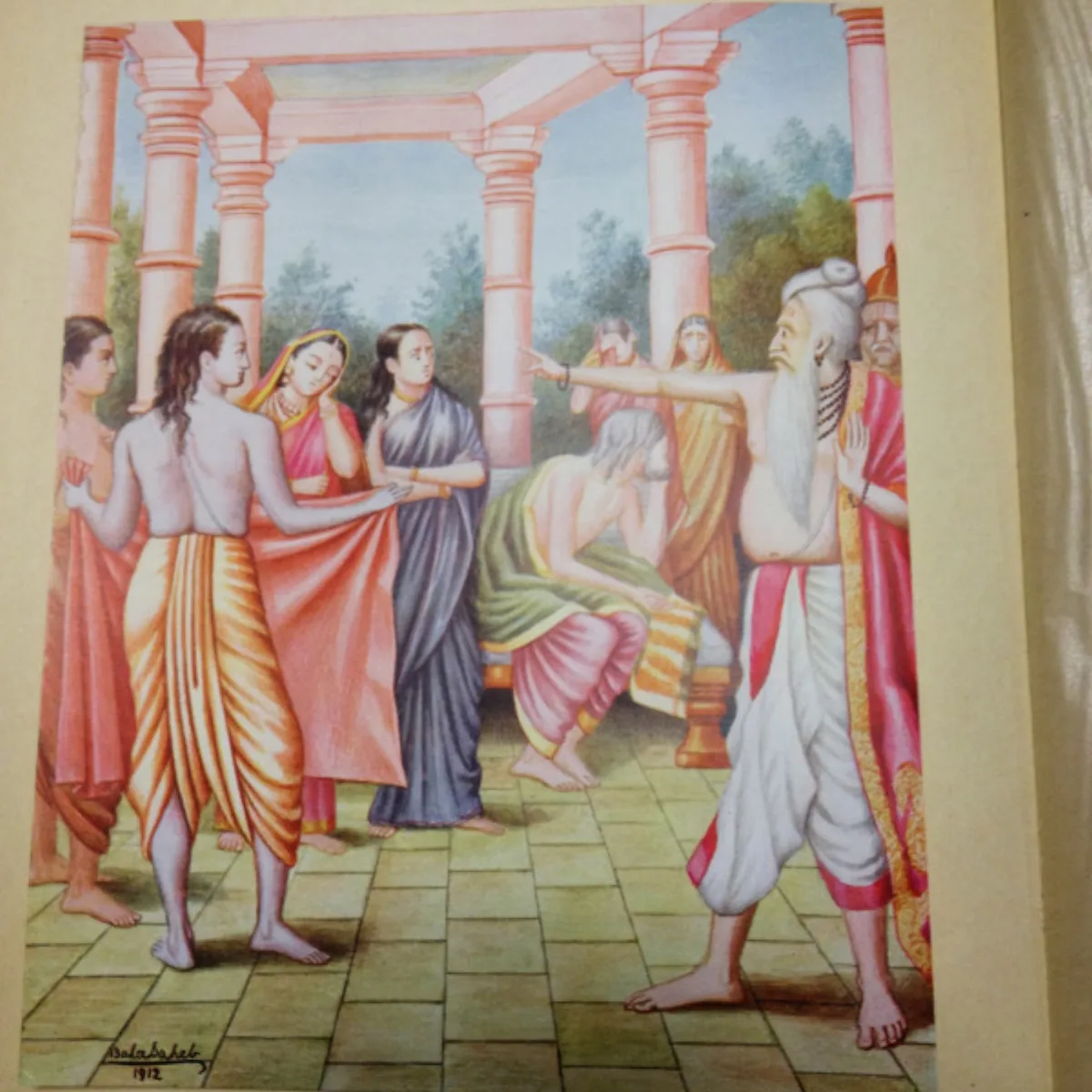
- 1916 Vasishta illustration and public-domain record
- Vasishtha Nadi tradition page
- Nandi Nadi guide
- Atri Nadi guide
- Nadi manuscript history
- How thumb matching works
Begin your personal leaf-finding journey
₹999 covers Guruji’s index-leaf search and live verification. When an index leaf matches, the continuation reading opens the deeper guidance preserved for your life, and the NadiVedas team explains the next step clearly.
Begin leaf finding for ₹999