A palm leaf can feel like a bridge across centuries. Its dark incised letters, cord holes and worn edges invite a powerful conclusion: the object in front of us must be the very leaf on which an ancient sage recorded a modern life. The real history is more complicated—and more interesting.
Nadi astrology belongs to a living South Indian spiritual and divinatory tradition, especially associated today with Tamil Nadu and Vaitheeswaran Koil. Its custodians tell sacred histories of sages who perceived future seekers and recorded their lives. Alongside that tradition sits the material history of palm-leaf books: leaves prepared by hand, texts copied and recopied, collections moved, catalogued, fragmented, conserved and digitised.
The history of Nadi astrology has two layers. In traditional belief, sages such as Agastya foresaw the lives of future seekers and preserved their readings on palm leaves. Historically, palm leaf was a major manuscript medium in South and Southeast Asia, and Tamil manuscript culture preserved many kinds of knowledge through copying and custodianship. Nadi reading is visibly practised in modern Tamil Nadu, but sweeping claims about the exact age, author or unbroken journey of a personal leaf are rarely established by public archival evidence. A careful account respects the tradition without presenting faith claims as proven chronology.
The sacred history told within Nadi tradition
The most familiar origin story begins with realised sages or rishis. Through extraordinary insight, they are believed to have perceived the karmic patterns and future circumstances of people who would seek guidance in a later age. Agastya is the name most often encountered, although traditions also invoke Suka, Bhrigu, Vasishta, Kausika, Kakabhujandar and other figures. Collections and reading methods may carry these lineage names.
In this account, a seeker does not meet the leaf by accident. The meeting happens when the right time arrives. A thumb impression helps a custodian narrow bundles; statements from candidate leaves are then tested until identifying details converge. The matched text may introduce the seeker, describe family circumstances and direct the reading into Nadi astrology Kandams concerning different areas of life.
This is a theological and practitioner account, not a laboratory finding. Phrases such as “according to Nadi tradition,” “devotees believe” and “the lineage attributes” are not evasions. They tell the reader what kind of claim is being made. The tradition can be described faithfully without declaring that every living person's biography has been scientifically verified on an ancient artefact.
Origin stories also vary. Some centres describe a dialogue between Shiva and Parvati; some focus on Agastya and the Siddha tradition; others narrate royal libraries, colonial sales or family rescues. Variation does not automatically disprove a living tradition, but it does mean that one promotional history should not be treated as the sole documentary record.
What a palm-leaf manuscript can—and cannot—establish
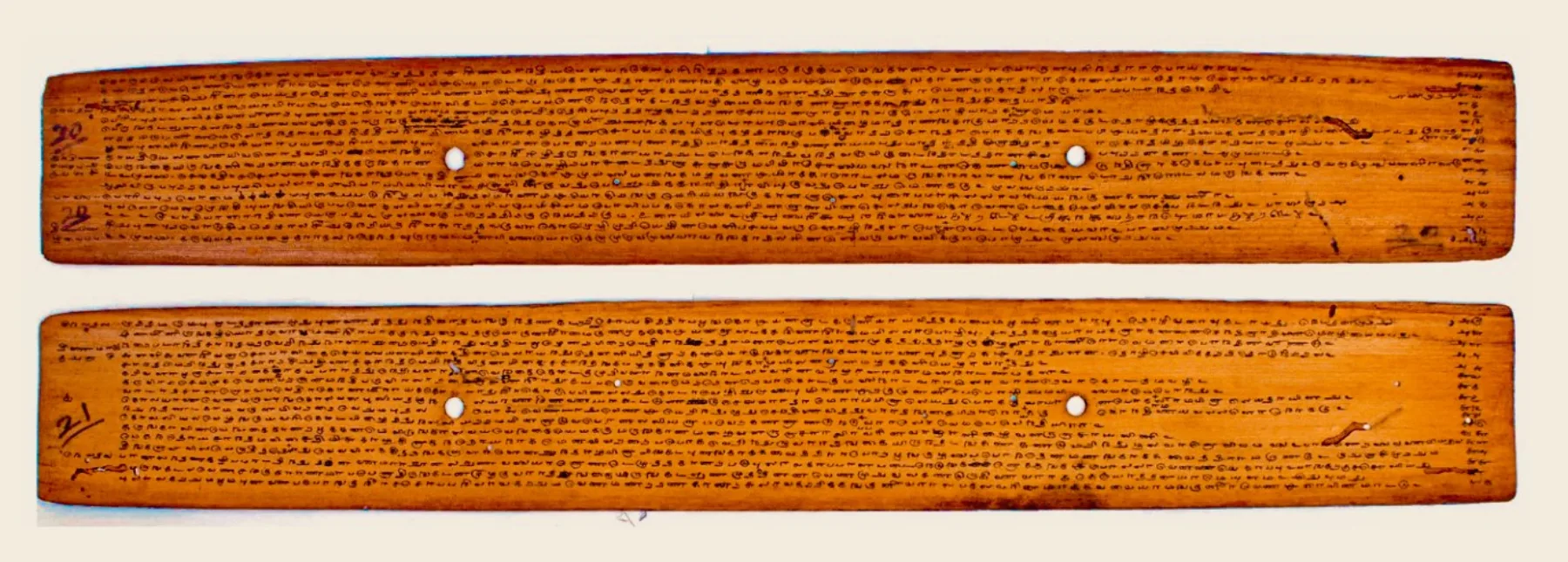
Palm-leaf manuscripts are real historical objects. Across India they preserve works on religion, literature, medicine, mathematics, ritual, law, astronomy, astrology and other subjects. Prepared leaves were inscribed, often darkened so the letters became visible, pierced and held together. Their physical form explains the familiar long, narrow page and cord holes.
But medium is not identity. An old Tamil palm leaf is not necessarily a Nadi life reading, just as an old paper book is not necessarily a horoscope. Script, language, title, colophon, contents, catalogue record and custody history all matter. Even when a leaf contains an astrological text, it may be a general treatise rather than a personal reading located through a thumbprint.
,_Languages_in_the_manuscript_Tamil_Telugu_Sanskrit,_Scripts_Grantha_Telugu_Tamil,_Hindu_Shaivism_monastery,_UVSL_589.jpg)
Scholars study handwriting, language, material features, colophons, later annotations and relationships between copies to understand a manuscript’s physical history. Nadi tradition adds a sacred dimension: the belief that guidance attributed to sages is encountered by the seeker at the destined time. Keeping the material history and living devotional meaning clear allows both to be appreciated respectfully.
A responsible timeline: what we can say with confidence
Long before the modern reading centre
Palm leaf became an important writing material across South Asia, and South India developed extensive manuscript cultures. Texts survived through networks of temples, monasteries, courts, scholars, libraries and households. This broad history is well documented; it should not be collapsed into the narrower claim that every surviving palm leaf is a Nadi record.
Copying as continuity
Because organic leaves deteriorate, scribes copied valued works onto replacement leaves. The intellectual work may therefore be older than the physical copy that survives. A modern-looking leaf does not automatically mean a modern composition, while an aged leaf does not automatically prove the claimed author or date. Textual age and object age must be kept separate.
Collections, catalogues and dispersal
Indian manuscript holdings became distributed among public repositories, religious institutions and private custodians. Colonial collecting and the antiquities market affected many collections, but a general story of dispersal does not document the route of a particular Nadi bundle. Provenance must be specific.
The visible modern practice
Today, Nadi Jothidam is strongly associated with Tamil Nadu, particularly Vaitheeswaran Koil Nadi astrology, and is offered both in person and remotely. Readers and custodial families maintain collections, classify thumb impressions, search bundles and translate texts. This contemporary practice is observable even when its most ancient claims remain matters of tradition.
A tradition may be old, a text may preserve older material, and a particular leaf may be a later copy. All three can be true at once.
Why recopying is central, not an embarrassing footnote
Heat, moisture, mould, insects, abrasion and repeated handling threaten palm leaf. Conservation bodies emphasise monitoring, appropriate storage, careful handling and documentation because damaged manuscripts cannot simply be replaced. Digitisation can preserve access to content and appearance, but it does not stop the original material from ageing.
Traditional copying was one answer to this fragility. A scribe transferred a valued text to new leaves, sometimes introducing spelling changes, corrections, comments or omissions. Multiple copies can form a textual family. For historians, those differences are evidence: they show how knowledge travelled and how communities decided what to preserve.
This matters when a provider says, “your leaf is 3,000 years old.” Which age is meant—the attributed revelation, a textual tradition, the exemplar from which a copy was made, or the physical leaf being handled? A transparent answer might acknowledge that a text is traditionally ancient while the present manuscript is a later copy. That answer is more credible, not less sacred.
Five layers of age to keep separate
✓ The sacred time described by the lineage
✓ The attributed sage or source
✓ The composition of the text
✓ The date of a surviving copy
✓ The date a bundle entered its current collection
Libraries, temples and custodial families
Popular histories often tell of one great library from which Nadi leaves were sold or scattered. Tamil repositories such as the Sarasvati Mahal Library are historically important, but that does not make every modern bundle traceable to them. A credible provenance statement should identify a catalogue, accession, family record, colophon or other concrete link rather than rely on a famous library's name.
Private custody is not automatically suspicious. Vast numbers of Indian manuscripts have remained with families, religious institutions and individual collectors. The National Mission for Manuscripts has highlighted how dispersed and incompletely catalogued India's manuscript heritage is. Private collections can preserve valuable traditions, yet limited public documentation also makes broad claims harder to verify.
Ask custodians how leaves are stored, whether they are originals or working copies, how bundles are labelled, and what happens when a leaf becomes too fragile to handle. Responsible care may mean that a reader works from a transcription, scan or renewed copy. Insisting on touching a brittle original for theatrical proof can damage the very heritage a seeker hopes to honour.
How to test a historical claim without becoming hostile
Begin with curiosity. “What does your lineage teach about this collection?” invites the traditional account. Then ask, “What is known about this physical copy?” The second question moves from belief to evidence without dismissing the first.
Useful details include the collection name, known custodians, script, language, approximate copy date, any colophon, cataloguing system and whether researchers have examined it. A reader may not know every palaeographic detail; honest uncertainty is preferable to an instant, precise date unsupported by documentation.
Watch for questions to clarify: every leaf described as an untouched original; a famous institution cited without a catalogue link; exact millennia-old dates assigned by appearance; claims that carbon dating proves a prediction; or criticism treated as spiritual danger. Provenance questions should not trigger fear, urgency or an expensive remedy.
During the actual search, historical grandeur should not replace procedural clarity. Learn how the thumb impression narrows bundles, answer candidate statements without volunteering a biography, and allow a non-match. A spectacular origin story cannot rescue a weak matching process.
Can a reading matter when the history is uncertain?
Yes—but be precise about why. A ritual or reading may offer reflection, cultural connection, spiritual language or a structured conversation about choices. Those experiences do not require a fabricated certificate of antiquity. They should also not be presented as scientific prediction or used instead of qualified medical, legal, financial or mental-health care.
Consider Meera, an illustrative seeker rather than a testimonial. Her matched reading contains specific family details she finds striking. She can record what information she supplied, evaluate the matching process, reflect on the interpretation and still say, “I do not know when this physical leaf was copied.” Wonder and uncertainty can coexist.
Arun takes another path. He values the Agastya attribution devotionally but declines a provider's claim that an urgent paid ritual is historically mandated. He reads the remedies guide, separates spiritual practice from sales pressure and chooses a simple act consistent with his beliefs.
A third seeker, Kavya, cannot travel. She uses an online Nadi reading, asks to see the candidate text on camera and requests a recording. Remote access neither proves nor disproves antiquity; it changes how she can observe, question and document the process.
A history-aware preparation checklist
- Read the centre's history page and mark which statements are framed as belief, family memory or documented fact.
- Ask whether you will see an original leaf, later copy, transcription or digital image.
- Request the collection and lineage name without assuming either proves age.
- Keep leaf-finding, full reading and remedies as separate decisions and payments.
- Share only the minimum information required before live matching.
- Ask permission to record the original-language reading and translation.
- Do not handle a fragile manuscript unless the custodian explicitly permits it.
- Write down both matches and misses before deciding what the experience means.
If you want to begin with the complete process, read what Nadi astrology is and the guide to the sixteen Kandams. At NadiVedas, ₹999 covers the index-leaf search and Google Meet verification. A match is not guaranteed; the separate continuation-bundle reading contains the future-prediction material, starts from ₹9,800 and varies by lineage and depth. No historical claim should pressure you to continue.
Frequently asked questions
How old is Nadi astrology?
Nadi astrology is traditionally described as ancient and attributed to sages. The age of a particular surviving leaf cannot be inferred from that tradition alone; palm-leaf manuscripts were often recopied because the material deteriorates in tropical conditions.
Did Sage Agastya write every Nadi leaf?
Many Nadi lineages attribute texts to Agastya, while others name sages such as Suka, Bhrigu or Vasishta. These are traditional attributions. Establishing the physical authorship and date of an individual manuscript requires provenance and specialist study.
Are Nadi manuscripts kept in one library?
No single public catalogue is known to contain every manuscript used for personal Nadi readings. Indian manuscripts are dispersed across libraries, religious institutions, private collections and custodial families.
Are all old Tamil palm leaves Nadi astrology leaves?
No. Palm-leaf manuscripts carry literature, medicine, ritual, grammar, philosophy, administration and many other subjects. A palm-leaf format or Tamil script does not by itself identify a manuscript as Nadi astrology.
What is Vatteluttu?
Vatteluttu is a historical script used in parts of South India. Websites often state that all Nadi leaves use it, but collections can involve different scripts, hands, languages, dates and later copies. Ask what script is actually present.
Why were palm-leaf manuscripts recopied?
Palm leaf is organic and vulnerable to humidity, insects, handling and breakage. Copying a text onto prepared new leaves could preserve its content even when the earlier physical carrier was failing.
Can a reader prove that my leaf is thousands of years old?
A verbal claim or matching session cannot prove an artefact's age. Dating and attribution depend on material examination, script, colophons, catalogue history and comparison with other manuscripts.
Does uncertain history make a reading meaningless?
Not necessarily. A seeker may find spiritual or personal meaning in a living tradition while remaining careful about historical claims. Meaning, predictive accuracy and manuscript provenance are separate questions.
How should I assess a Nadi centre's history claims?
Ask for the collection or lineage name, known custody history, script and language, whether the leaf is an original or copy, and which claims are tradition rather than independently documented fact.
How does NadiVedas begin a search?
₹999 covers Guruji's search for and live verification of the index leaf. If it matches, the separate continuation-bundle reading contains the future-prediction material and starts from ₹9,800. A match is not guaranteed.
See how the tradition is practised today
Move from manuscript history into the living reading process, the temple town most associated with it and the questions to ask before a session.
Let history deepen the question—not force the answer
A careful leaf search can respect lineage and evidence at the same time. Begin with clear terms, limited personal data and room for a genuine non-match.
Begin leaf finding for ₹999