
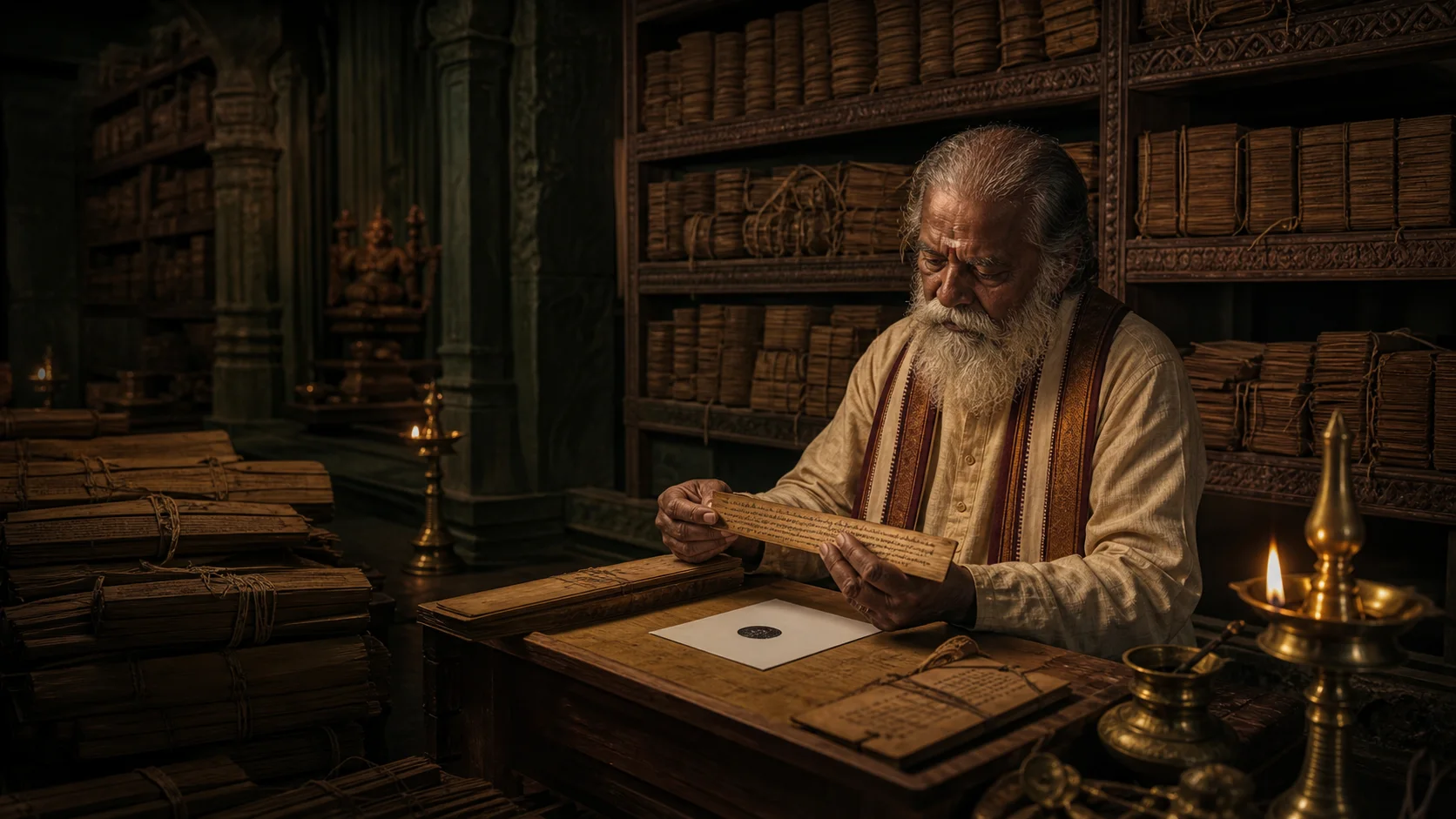
Imagine entering a library where the catalogue does not begin with an author, a title or even a date. It begins with the ridges of your thumb. A reader studies the impression, disappears among tied bundles of narrow brown leaves and returns with a small number of possibilities. Then the real test begins: not a performance in which you tell your life story, but a process of elimination in which the manuscript must appear to tell yours.
That image explains why Nadi astrology inspires fascination, devotion and scepticism in equal measure. It also explains why a useful guide must do more than repeat a dramatic claim. A seeker needs to understand the tradition’s own account, the practical sequence of a search, the limits of what can be promised and the questions that protect an honest experience.
Nadi astrology—also called Nadi Jyotisha or Nadi Jothidam—is a South Indian palm-leaf manuscript tradition. Practitioners search for a record believed to correspond to a seeker, commonly using a thumb impression to narrow the archive. Candidate leaves are tested in a live yes-or-no matching session. If one leaf consistently identifies the seeker, its available chapters may then be read. These spiritual claims are matters of tradition and belief, not established scientific facts.
What does “Nadi astrology” actually mean?
The phrase is used in more than one Indian context. In this guide, it refers specifically to the Tamil palm-leaf reading tradition—not the yogic energy channels called nadis and not the Nadi compatibility category used in some forms of horoscope matching. This distinction matters because the same word “Nadi” can describe three unrelated ideas.
In the palm-leaf tradition, collections of manuscripts are associated with sages or sacred lineages. The central belief is that particular life records were perceived by enlightened seers and preserved for the people who would eventually seek them. The manuscript is therefore treated as something to be found and verified, rather than a horoscope created for the visitor on the day.
That difference shapes the entire encounter. A conventional Vedic astrology consultation usually calculates and interprets a birth chart from date, time and place. A Nadi search commonly starts with a thumb impression. Birth-related information may become part of the later verification, but it should not need to be supplied as a complete biography before the search begins.
From oral tradition to palm-leaf manuscript
Nadi narratives commonly attribute the knowledge to sages such as Agastya, while other traditions describe sacred dialogues—for example, words spoken between Lord Shiva and Parvati. These attributions belong to religious and lineage history. Surviving manuscript collections, meanwhile, exist within the broader South and Southeast Asian practice of recording texts on prepared palm leaves.
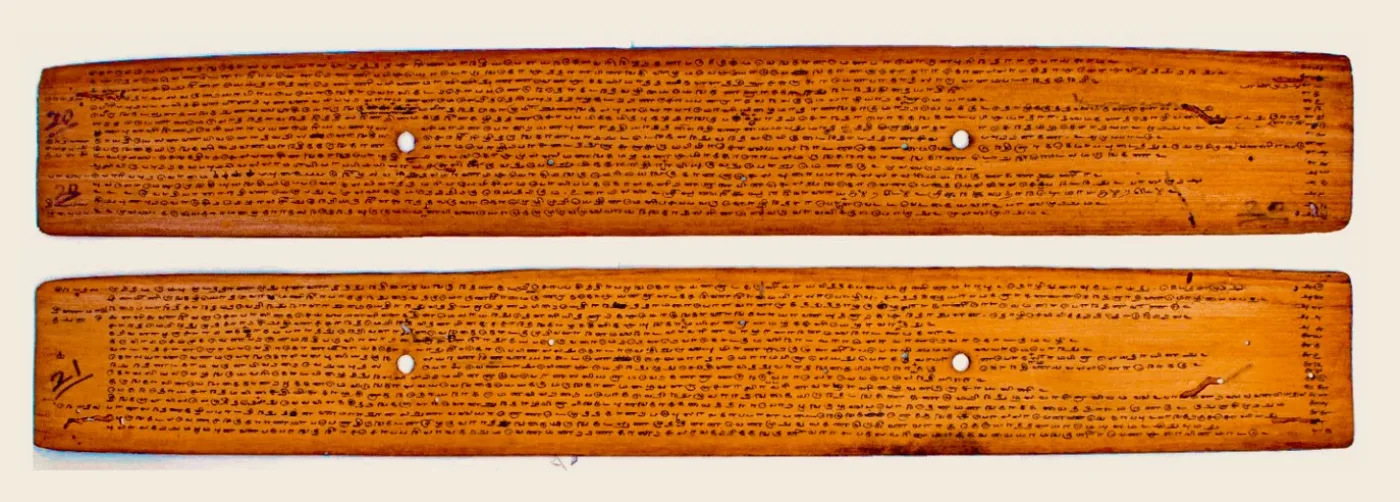
A palm-leaf manuscript is not a modern sheet of paper. Leaves were prepared, dried, cut into long strips and inscribed, often by scratching characters into the surface before applying pigment. Holes allowed leaves to be strung and stored between covers. Climate, insects and repeated handling made preservation difficult, so manuscripts could be recopied by later custodians. That reality helps explain why “ancient knowledge” and the physical age of any individual surviving leaf are not necessarily the same claim.
,_Languages_in_the_manuscript_Tamil_Telugu_Sanskrit,_Scripts_Grantha_Telugu_Tamil,_Hindu_Shaivism_monastery,_UVSL_589.jpg)
Vaitheeswaran Koil in Tamil Nadu is widely associated with Nadi reading, although manuscript libraries and reading families are not limited to one location. Different custodians preserve different collections, methods and lineage stories. There is no single universal archive containing every Nadi leaf, and no responsible explanation should imply that every person is guaranteed to have a discoverable record in a particular library.


How a Nadi palm-leaf reading works, step by step
1. The seeker books a leaf search
The first transaction should be for the work of searching, not a promise that a prediction has already been found. At NadiVedas, leaf finding costs ₹999. If no matching leaf is found, that fee is refunded. A full reading is a separate choice made only after a match.
2. A thumb impression is submitted
Many Tamil Nadi conventions use the right thumb for men and the left thumb for women. A clear, complete ridge impression matters more than an attractive photograph. The print functions like a catalogue key: it directs the reader toward one portion of the collection.
3. Likely bundles are selected
The reader or library team classifies the print and retrieves candidate bundles. Traditional accounts describe numerous primary patterns and subtypes. Public explanations often mention 108 classifications, but terminology and counting can differ between centres; it is wiser to understand the principle than to treat one number as universal.
4. Leaves are tested during a live call
The reader voices statements from a candidate leaf. The seeker responds yes or no. A wrong statement eliminates that leaf; a correct statement allows the reader to continue. Translation may be needed when the manuscript or reader uses Tamil and the seeker prefers another language.
5. One leaf must produce a coherent match
A credible match does not rest on one broad sentence. Several identifiers should converge on the same leaf: aspects of the seeker’s name, parents, family structure, marriage status, profession or birth markers may be tested. The exact sequence varies, but consistency is the point.
6. The optional full reading is explained
After matching, the centre can explain the lineage, available Kandams, expected duration and price. NadiVedas full readings start from ₹9,800 and vary by lineage and depth. A seeker should be free to stop after matching, ask questions or schedule the reading later.
Why does the search begin with a thumb impression?
The simplest helpful analogy is a library catalogue. Your fingerprint does not contain a miniature prediction that the reader decodes. Instead, its visible ridge pattern is used to narrow a very large collection into a smaller family of bundles. The manuscript—not the fingerprint—is then expected to supply identifying statements.
This is also why a thumb impression does not establish that a leaf belongs to you. Thousands of people can share a broad ridge-pattern category. Classification reduces the search space; the matching conversation tests the candidate. Confusing these two stages makes the process sound either more scientific or more magical than practitioners themselves need to claim.
For a useful submission, place the entire thumb pad on clean white paper with dark ink, avoid smudging and photograph it in even light. Do not crop away the edges of the pattern or use beauty filters. A centre that cannot read the ridges should ask for a clearer impression rather than pretending certainty.
The emotional centre of the experience: the matching conversation
For many seekers, matching is the moment curiosity becomes intensely personal. A general statement can be coincidence. A sequence that appears to move through family names, relationships and life markers feels different. That emotional force is precisely why the session needs disciplined boundaries.
Answer only the question asked. “Yes,” “no” and “I do not understand—please repeat” are usually enough. Avoid correcting the reader with the right information after a wrong statement. Do not explain your recent problems while leaves are still being eliminated. Every extra clue makes it harder for you to judge what came from the manuscript and what came from the conversation.
A reader should also be comfortable abandoning a candidate. If answers become increasingly strained—“almost,” “perhaps,” or “it could mean”—pause. Translation and variations in names can require sensible clarification, but repeated reinterpretation should not be used to rescue a weak match. An honest search can end with no leaf found.
“The goal is not to make a leaf fit your life. The goal is to discover whether one leaf identifies your life without being coached.”
What are the 13 Kandams?
Kandam means a section or chapter. Nadi reading systems commonly organise material into life areas that parallel familiar themes in Indian astrology. Naming and availability can vary, but the framework helps seekers choose depth instead of purchasing everything without understanding it.
- General life: identity, broad life pattern and foundational overview.
- Family and wealth: speech, resources and immediate family.
- Siblings and courage: communication, initiative and siblings.
- Mother and home: property, education, emotional foundations and mother.
- Children and intelligence: children, creativity and learning.
- Health and obstacles: illness, conflict, service and challenges.
- Marriage and partnership: spouse, relationships and partnership.
- Longevity and transformation: major transitions and hidden matters.
- Fortune and dharma: teachers, blessings, pilgrimage and purpose.
- Career and authority: profession, responsibility and public life.
- Gains and aspirations: networks, fulfilment and income.
- Expenditure and liberation: foreign connections, release and spiritual direction.
- Past-life karma and remedies: traditional karmic explanations and prescribed spiritual responses.
Remedies may involve prayer, charity, temple worship or other spiritual acts. Guruji can explain how a recommended practice connects with the matched passage, what it involves and how it supports the seeker’s wider journey.
Agastya, Shiva Vakya and other Nadi lineages
“Which Nadi is best?” is usually the wrong first question. A better question is: what kind of clarity are you seeking, and what depth can the available manuscript tradition responsibly offer? Lineage names signal sacred attribution and reading character, not a universal quality ranking.
Shiva Vakya Nadi is presented through the dialogue of Lord Shiva and Parvati and is often chosen for an expansive view across relationships, work, family karma and spiritual direction. Agastya Nadi, associated with Sage Agastya, is commonly positioned as a foundational and practical life reading. Other offerings may include Vashishta, Kakabhushundi, Bhogar, Atri, Bhrigu, Nandi, Dhanvantari, Shukra, Thirumoolar and Brahma traditions.
Descriptions differ across libraries because collections and inherited practices differ. Before selecting, ask what the reading includes, whether the leaf search is actually conducted within that named collection, how long the session normally lasts and what happens if the leaf cannot be verified.
Can an online Nadi reading be authentic?
An online session changes the meeting place, not necessarily the manuscript process. The reader can remain with the physical library while the seeker joins by video. A clear camera, stable audio and competent translation can allow the same yes-or-no elimination that would occur across a table.
The real question is not “online or in person?” but “what is happening behind the screen?” Ask whether a physical leaf is being retrieved, whether you will see the manuscript, whether matching occurs live and whether the recording or translated notes will be provided. A digital appointment should increase transparency, not obscure the process.
Online access is especially valuable for seekers outside Tamil Nadu or India, but convenience should not create urgency. Choose a quiet place, keep enough uninterrupted time, use headphones if privacy matters and resist the temptation to research every possible answer during the call. Presence is more useful than performance.
Is Nadi astrology real? A better way to evaluate the question
Nadi astrology makes spiritual and historical claims that modern science has not established. Believers may understand a powerful match as evidence of destiny, grace or the sages’ perception. Sceptics may consider probability, prior information, suggestive questioning, translation flexibility and cold-reading techniques. A trustworthy guide should not erase either perspective.
You can, however, evaluate the integrity of a specific process. Was unnecessary personal information collected before matching? Were statements specific? Did several identifiers align on one leaf? Were wrong leaves discarded cleanly? Did the reader pressure you? Was the no-match and refund policy clear? These questions do not settle metaphysics, but they protect your ability to assess the encounter honestly.
Questions to clarify before continuing
- A guaranteed leaf or guaranteed outcome before any search.
- Requests for a complete biography before matching.
- Remedy recommendations without a clear purpose, practice or price.
- Repeatedly converting wrong statements into vague “symbolic” matches.
- No written explanation of fees, refunds or what the first payment covers.
- Pressure to purchase every chapter immediately.
- Claims that spiritual guidance should replace professional care.
How to prepare for your first Nadi search
Begin by writing down what you want from the experience. Curiosity, spiritual reflection and a desire for direction are different intentions. A clear intention helps you choose a lineage and reading depth later without forcing the matching session to answer every question at once.
Read the centre’s process and refund policy before paying. Confirm what the leaf-finding fee covers, which thumb to submit, how the call will be arranged, what languages are available and whether the full reading is optional. Save the confirmation and support contact.
During matching, protect the information boundary. Give the minimum required booking details, answer yes or no, and ask for repetition when necessary. After a match, take a pause. Understand the proposed reading, its chapters, duration and price. Spiritual significance does not require an impulsive decision.
A five-minute checklist
✓ Clear thumb impression
✓ Quiet room and stable connection
✓ No biography prepared for the reader
✓ Written refund and pricing terms reviewed
✓ Freedom to continue—or stop—after matching
What Nadi astrology can—and cannot—offer
At its best, a Nadi reading can become a structured moment of reflection: a way to examine choices, relationships, obligations and spiritual practice through an inherited cultural lens. For a believer, it may feel like recognition across centuries. For a curious visitor, the matching process itself may be the central experience.
Nadi guidance can bring a meaningful spiritual perspective to life’s uncertainty. Predictions illuminate possible periods and patterns, while remedies translate the message into prayer, discipline, charity or worship that the seeker can practise with understanding.
The most respectful approach is neither blind belief nor automatic dismissal. Learn the process. Protect the matching conditions. Notice what is specific and what is broad. Ask how the tradition is being represented. Then decide what meaning, if any, the experience holds for you.
Frequently asked questions
What is Nadi astrology?
Nadi astrology is a South Indian divination and manuscript tradition in which readers search collections of palm-leaf records for a leaf believed to correspond to an individual. The search commonly begins with a thumb impression and continues through a live yes-or-no matching process.
Which thumb is used for a Nadi reading?
In the convention followed by many Tamil Nadi centres, men provide the right thumb and women provide the left. Practices can differ between libraries, so follow the instructions of the centre conducting the search.
Do I need my exact birth time?
An exact birth time is generally not required to begin the leaf-finding stage. A matching leaf may itself contain birth-related identifiers, which are tested during the live session.
Is a Nadi leaf guaranteed to be found?
No responsible centre should guarantee a match. A search may end without a suitable leaf, and an honest no-match is preferable to forcing unrelated statements to fit.
Can a Nadi reading be conducted online?
The matching conversation and reading can be conducted by video call when the physical manuscript search remains with the reader and the seeker can hear, answer and receive translation clearly.
What happens after my leaf is matched?
The reader can explain available chapters, the chosen lineage, reading depth, duration and fee. Continuing to a full reading should remain the seeker’s choice.
Explore the parts of the Nadi journey
Go deeper into the three questions most seekers ask next: how the leaf is found, what the chapters contain and how to prepare.
Could one of the leaves identify you?
Begin leaf finding for ₹999. If no matching leaf is found, the fee is refunded. Full readings are optional and paid only after a successful match.
Begin leaf finding →