
A reading has ended, but the room has not relaxed. The seeker has just heard a difficult karmic story. Then comes a list: visit a temple, light lamps, feed people, commission a ritual, repeat a mantra. In that emotionally open moment, a spiritual invitation can feel like an unavoidable invoice.
The tradition deserves a better conversation. Remedies can be meaningful acts of worship, generosity and discipline. They can also be marketed with certainty that neither history nor evidence supports. Understanding the difference lets a seeker honour faith while keeping consent, proportionality and ordinary judgement intact.
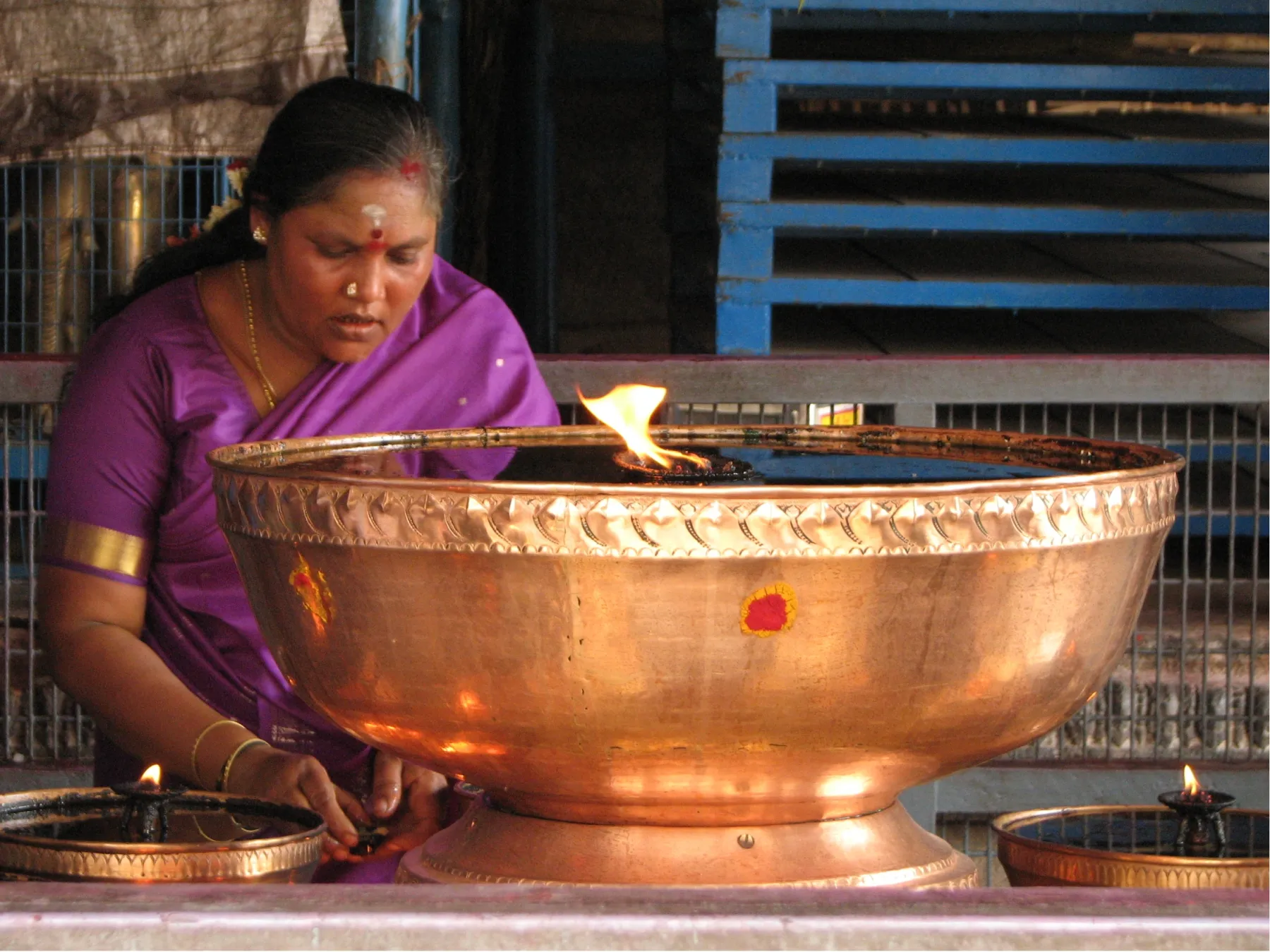
Nadi astrology remedies—often called Pariharam—are spiritual observances recommended in some palm-leaf readings to respond to difficulties understood through karma, past actions or planetary influence. Common forms include prayer, mantra, charity, temple visits, puja, homa and personal discipline. Shanti and Deeksha chapters are often associated with these practices. A meaningful remedy is clearly explained, freely chosen and separately priced, allowing devotion to support the seeker alongside responsible medical, legal, financial or emotional care.
What a remedy means inside the Nadi tradition
Many Nadi lineages do not present destiny as a passive script. A reading may describe inherited tendencies or consequences of action, then prescribe an act intended to cultivate peace, responsibility or devotion. The Tamil word pariharam commonly refers to a remedial or expiatory observance. Shanti suggests peace or pacification; deeksha suggests initiation or committed spiritual instruction.
Within the belief system, a difficulty may be interpreted through karma from this life or a previous birth. A remedy is then framed as a constructive response: worship rather than panic, charity rather than self-absorption, discipline rather than helplessness. This theological account is meaningful to many practitioners, but a past-life explanation cannot be verified as an established historical fact about an individual.
It is also important not to confuse two different uses of “Nadi.” Nadi astrology is the palm-leaf reading tradition discussed here. “Nadi dosha” in marriage compatibility is a different Jyotisha concept. A page that jumps between them without explanation may answer the wrong question.

Shanti and Deeksha: where remedies often appear
Current practitioner lists commonly place remedial material in specialist chapters after the general reading. Shanti is often numbered Kandam 13 and connected with karmic narratives, ancestral themes and acts intended to bring peace. Deeksha is often numbered Kandam 14 and connected with mantra, sacred discipline, yantra or instruction from a teacher.
These labels are not perfectly standard. One library may spell the term Diksha or Theetchai; another may combine remedial material with a different chapter. Some readings mention simple observances inside the general chapter. Ask the reader to describe the content in plain language instead of assuming that every numbered list online applies to every archive.
A seeker does not need to purchase every chapter to prove sincerity. First confirm the candidate leaf through the Nadi thumb-impression and live-matching process. Then understand the general reading. Only after that should optional Nadi astrology Kandams or remedies become a separate choice.
Six common forms of Nadi remedies
Prayer & mantra
Recitation directed to a deity or spiritual ideal, sometimes for a stated number of days.
Temple worship
A visit, lamp offering, abhishekam or archana at a named temple or sacred place.
Charity & service
Food, clothing, education support, animal care or another act of giving and responsibility.
Homa & puja
A commissioned fire ceremony or ritual worship, performed personally or by a priest.
Pilgrimage
Travel to one or more sacred sites, often with a sequence of prayers or offerings.
Yantra or talisman
A sacred diagram or object prepared and used according to lineage instructions.
Simple personal practices
Prayer, mantra, lighting a lamp, fasting or a daily discipline can be performed by the seeker. Clarify pronunciation, duration, frequency and whether adaptation is allowed for disability, work, pregnancy, health or religious conscience. A practice should not become physically unsafe or psychologically obsessive.
Charity and service
Giving food, clothing, money or time can express dharma and repair. Ask who receives the contribution and whether you can give directly to a transparent organisation of your choice. Charity is not a purchase of guaranteed fortune. Its immediate, observable value is the help it provides.
Temple and priest-led observances
Temple visits, archana, abhishekam, puja and homa involve place, materials and trained officiants. Request the temple name, ritual name, date, inclusions and cost. If travel is impossible, ask whether the intention can be honoured through a local temple or a simpler personal act.
Objects and talismans
A yantra, amulet or sacred plate may carry lineage meaning. Ask what material it uses, whether any handling instructions are practical, who made it and what the price covers. Treat extraordinary claims about protection from illness, violence or “black magic” as belief claims, not guarantees.
How a remedy should be connected to the reading
A remedy should follow an intelligible chain. The reader identifies the relevant manuscript passage, translates the stated concern, distinguishes the leaf's words from commentary, and explains how the proposed observance relates to it. If the prescription comes entirely from the centre's standard package, that should be disclosed.
Ask for the remedy in writing. The record should name the practice, purpose within the tradition, who performs it, timing, repetition, materials and complete price. A translated recording helps you compare the spoken leaf with the later summary. It also reduces the chance that an optional suggestion becomes remembered as a command.
Personalisation should not be a reason for secrecy. Some mantra instructions may traditionally be private, but privacy is different from refusing to disclose cost, practitioner, safety or deliverables. A provider can respect sacred context while giving usable consumer information.
A spiritual remedy can ask for devotion. It should not ask you to abandon questions.
A five-part test before saying yes
- Meaning: Can you explain the practice and its spiritual purpose in your own words?
- Consent: Can you pause, adapt or decline without being threatened with harm?
- Proportion: Is the time, travel and money reasonable for you?
- Transparency: Do you know who performs it, where funds go and what you receive?
- Safety: Does it coexist with professional care and avoid dangerous substances or behaviour?
If one answer is no, wait. Request a simpler version: personal prayer instead of an expensive proxy ritual, direct charity instead of an opaque donation, or a nearby temple instead of urgent travel. A reader may explain that the traditional instruction is specific; you still retain the choice not to proceed.
Accessibility and conscience are valid parts of the decision. A person who cannot climb temple steps, travel, fast, recite in Sanskrit or take part in a ritual outside their own faith should ask for an equivalent act that respects their capacity. The answer may be local worship, seated prayer, listening rather than recitation, service, or no remedy at all. Adaptation is not dishonesty when it is discussed openly. A provider should never shame disability, poverty, language or religious difference.
Questions to save before the call
✓ Is this written on the leaf or suggested by the reader?
✓ Is it optional?
✓ What is every step and the total cost?
✓ Can I perform it personally or locally?
✓ Who receives a donation?
✓ Who performs a proxy ritual and when?
✓ What proof of completion is provided?
✓ Does it involve health, fasting, substances or physical risk?
✓ May I decide tomorrow instead of today?
Proxy rituals, evidence and pricing
A proxy service means a priest or centre performs an observance for the seeker, often at a distant temple. This can be convenient and legitimate as a religious service, but the transaction should be explicit. Obtain the officiant or institution, location, intended date, ritual contents, materials, tax treatment, cancellation rule and what record will be shared.
Keep the original prescription beside the quotation or invoice. If the list changes later, ask why and request the revision in writing. This small step separates the reading from sales follow-up and helps family members understand what was actually agreed. For a multi-day observance, confirm whether the price covers every day, priestly fees, materials, temple charges, delivery and any final ceremony.
A photograph or video can document that an event occurred, but it cannot prove a promised supernatural result. Generic footage should not be represented as your ceremony. Conversely, a ritual need not become a film production to hold spiritual meaning. Agree on the deliverable before paying.
There is no universal “correct” price for Nadi remedies. Costs vary from almost nothing for personal practice to substantial travel and ceremony expenses. Itemisation makes comparison possible. Beware of a low headline price followed by mandatory materials, urgent upgrades or unexplained “energy” charges. India's consumer-protection guidance addresses misleading advertisements and hidden commercial practices; spiritual framing does not remove ordinary expectations of truthful claims and clear prices.
Health, pregnancy and mental wellbeing require firm boundaries
A prayer or temple visit may support reflection and community, but it is not a medical diagnosis or guaranteed treatment. Do not stop medicine, delay screening, avoid emergency care or substitute ritual for a qualified clinician because of a reading. The World Health Organization supports respectful study of traditional practices while emphasising evidence, safety, quality and appropriate integration with biomedical care.
Fast only if it is safe for your health. Pregnant people, children, older adults and people with diabetes, eating disorders or other conditions may need medical advice or an alternative observance. Do not ingest ash, herbs, metals or unknown substances without understanding contents and risks.
Predictions about death, infertility, curses or family harm can cause serious distress. A remedy seller should never create fear and then monetise relief. If a reading triggers panic, insomnia or compulsive ritual, step away and speak with someone trustworthy or a qualified mental-health professional. Your wellbeing is not evidence of weak faith.
How to choose remedies with clarity
Pause when a provider says the remedy must be purchased before sunset; guarantees marriage, pregnancy, profit, visa approval or cure; claims only its priest can prevent disaster; repeatedly increases the price; refuses an itemised description; or asks you to borrow money. Urgency should come from a real logistical deadline, not a frightening prediction.
Also question remedies intended to control another person's will, punish an enemy or isolate you from family and professional advice. Do not give card PINs, one-time passwords, remote device access or unnecessary identity documents. Use a named business payment route and preserve receipts and messages.
A compassionate reader can hold a strong spiritual belief without claiming certainty. They can say, “In this tradition, this observance is recommended,” rather than “Pay now or this event will happen.” That difference protects both devotion and dignity.
A grounded way to practise a chosen remedy
Begin by stating your intention in ordinary language: remembrance, generosity, discipline, reconciliation or prayer. Follow the agreed practice without constantly testing whether the universe has produced a reward. Keep a modest record of dates and reflections if useful, but do not reinterpret every coincidence as confirmation.
Pair spiritual action with practical action. A charity remedy can sit beside a budget; a relationship prayer beside honest communication and safety; a career observance beside applications and skill-building; a health prayer beside clinical care. Tradition becomes more humane when it strengthens responsibility rather than replacing it.
You may complete a remedy and experience peace, no obvious change or an outcome you cannot attribute. All are possible. The scientific effectiveness of personalised Nadi remedies has not been established. Their most defensible role is voluntary religious practice, not contractual control over future events.
If you are only beginning, read the complete guide to Nadi astrology, review the online Nadi reading safeguards, and understand the NadiVedas leaf-finding process. ₹999 covers finding and verifying the index leaf. The separate continuation-bundle reading contains the future-prediction material and starts from ₹9,800; any later remedy remains another decision—not an automatic requirement.
Frequently asked questions
What are Nadi astrology remedies?
They are spiritual practices that may be recommended after a Nadi reading. Within the tradition, they are understood as responses to karmic or planetary difficulties and may include prayer, charity, temple worship, mantra, homa or personal discipline.
Are Nadi remedies compulsory?
No. A seeker should be free to accept, adapt, postpone or decline a remedy. A reader should explain its meaning, steps and total cost without using fear or claiming that refusal guarantees harm.
What is Pariharam in Nadi astrology?
Pariharam is a Tamil and Sanskrit-derived term commonly used for a remedial or expiatory observance. Its form varies by lineage and may involve worship, offerings, service, charity, pilgrimage or a repeated personal practice.
What are Shanti and Deeksha Kandams?
Shanti material is commonly associated with karmic narratives and peace-making observances. Deeksha commonly concerns mantra, initiation or longer-term spiritual discipline. Names and contents vary across libraries.
Can someone perform a remedy on my behalf?
Some centres offer proxy rituals, but this is a service model rather than a universal rule. Ask who performs it, where, when, what evidence of completion is provided and whether a personal alternative exists.
Do Nadi remedies cure illness?
There is no basis for guaranteeing that a spiritual remedy will diagnose or cure illness. It may have devotional meaning, but it should not replace medical assessment, prescribed treatment or emergency care.
How much should a Nadi remedy cost?
There is no universal price. Simple prayer, service or charity can cost little, while travel or commissioned rituals cost more. Request an itemised price and decide after the reading rather than under pressure.
Can I do index-leaf finding without buying remedies?
Yes. Index-leaf finding, the continuation-bundle reading and any remedy are separate decisions. ₹999 covers index-leaf finding; continuation-bundle readings start from ₹9,800, and remedy decisions come later.
Place remedies in the wider reading journey
Learn how a leaf is matched, what the chapters cover and how to prepare without committing to later spiritual services.
Begin without committing to remedies.
₹999 covers index-leaf finding. The separate continuation-bundle reading starts from ₹9,800; any spiritual observance remains another later choice.
Begin index-leaf finding · ₹999