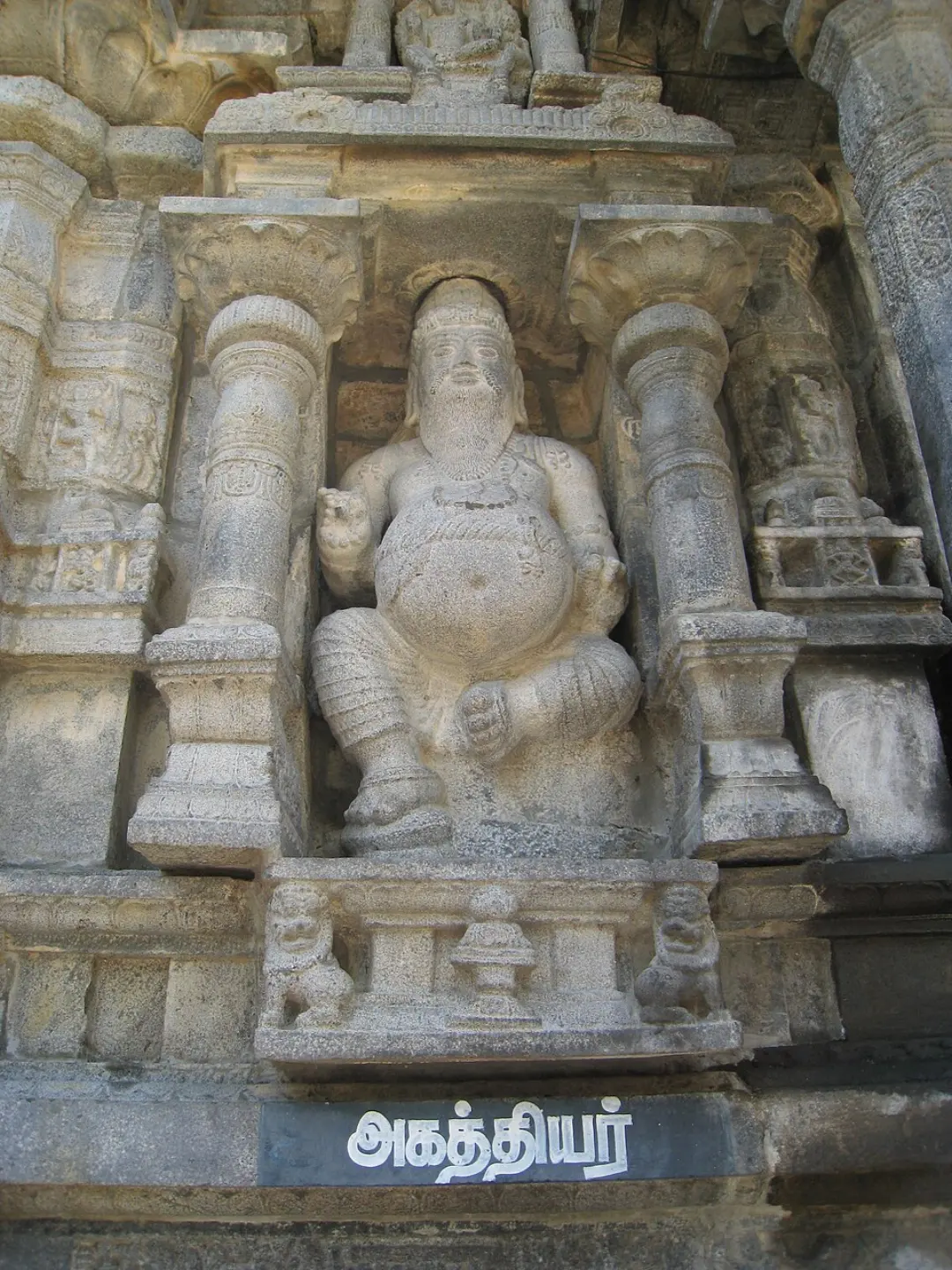
A seeker hears the name “Agastya” before she sees a leaf. It arrives with the gravity of mountains, medicine, Tamil learning and a sage said to have carried sacred knowledge south. Then a modern question follows: if a centre calls its service “Agastya Nadi,” what exactly is being claimed?
The answer matters because the name can refer to several layers at once: a revered figure known across Indian religious literature, the Tamil Siddha tradition, writings attributed to Agastya, a lineage of palm-leaf readings and a present-day business label. These layers overlap in devotion, but they are not interchangeable as historical evidence.
Agastya Nadi astrology is a South Indian palm-leaf divination tradition attributed to Sage Agastya, known as Agasthiyar, Agathiyar or Akattiyar in Tamil contexts. In a typical modern reading, a thumb impression helps select manuscript bundles; candidate identity statements are tested; and a matched index leaf is translated before optional chapters are offered. Agastya's importance in Indian and Tamil sacred traditions is well established, and palm-leaf manuscript culture is real. The stronger claim—that the sage personally foresaw a particular modern life and authored its leaf—is a matter of tradition, not verified history or scientific proof. Evaluate the attribution, physical manuscript, matching process, translation and provider separately.
Who is Sage Agastya in Indian and Tamil traditions?
Agastya is a many-sided figure. Sanskrit literature remembers him as a rishi; Tamil traditions revere Akattiyar as a formative Siddhar; temple narratives connect him with Shiva, sacred geography and the movement of knowledge toward the south. Later traditions associate his name with grammar, medicine, alchemy, yoga, ethics and astrology.
Those associations do not form one simple biography. Religious figures accumulate stories across languages, regions and centuries. A Puranic episode, a temple legend, a Siddha medical text and a modern Nadi lineage may each invoke Agastya for different reasons. Their value can be devotional, literary or cultural even when they cannot be arranged into a single documented timeline.
Current institutional work reflects that breadth. A Ministry of Culture conference abstract on Agasthiya-attributed Tamil manuscripts describes material spanning Siddha medicine, astrology, alchemy, linguistics, yoga and ethics, while explicitly using the language of tradition and attribution. That is useful evidence for the reach of the Agastya corpus—not proof that every work bearing his name came from one historical hand.
Agastya is best understood as a sacred authorial presence across a long tradition, not as a modern bibliographic record with one verifiable list of works.
Agastya, Agasthiyar, Agathiyar and Akattiyar
The tradition is known through several spellings: Agastya Nadi, Agasthiya Nadi, Agasthiyar Nadi and Agathiyar Nadi. They usually point toward the same revered sage through different languages and transliteration habits. Sanskrit “Agastya” and Tamil forms commonly rendered as “Agathiyar” or “Akattiyar” do not create separate traditions merely because English spelling changes.
However, the service behind the label may differ. One centre may use “Agastya Nadi” for a thumb-impression palm-leaf search. Another may use the name for chart-based Nadi astrology. A third may treat it as a broad brand that also covers temple rituals, homam, horoscope readings and remedies. The familiar name does not define a universal method.
Ask the label to do less—and the provider to explain more
✓ Is this a physical palm-leaf search or chart calculation?
✓ Which collection or lineage is called Agastya Nadi?
✓ How is a candidate leaf selected and rejected?
✓ Which language and script are read?
✓ Who translates and who interprets?
✓ What is included before any extra chapter or remedy?
Three histories sit behind one Agastya Nadi claim
The sacred history says that Agastya and other sages, through extraordinary perception, knew the lives of people who would arrive in the future and preserved guidance for them. Within the tradition, the seeker's eventual meeting with a leaf may itself be understood as karmically timed.
The textual history is more complicated. Palm leaves are perishable and often recopied. Texts attributed to a sage may have been transmitted, expanded or reorganised across generations. A later physical copy can carry an older work; an old object can also carry a text whose authorship is uncertain. The date of a leaf, text and traditional teaching are different questions.
The service history concerns how families and centres acquired, classified, read and marketed particular collections. Stories about royal libraries, colonial-era dispersal and hereditary custody are often repeated online. Some may preserve family memory, but a repeated story is not automatically a documented chain of custody. Ask what the centre knows, what it believes and what records it can show.
Our Nadi history and manuscript guide examines preservation, recopying and evidence in greater depth. The essential point here is simple: questioning provenance does not insult Agastya. It prevents a sacred name from being used as a shortcut around ordinary verification.

How an Agastya Nadi reading usually works
Many palm-leaf centres begin by requesting a thumb impression. A common convention uses the right thumb for men and the left for women, although practice and gender assumptions vary. The print is classified into a category associated with one or more manuscript bundles. It does not, by itself, reveal a complete life story.
The reader then tests candidate leaves. Statements may concern name sounds, parents, siblings, marriage, occupation or other identity details. The seeker responds yes, no or unclear. A candidate that fails should be set aside; a sequence that fits is used to identify an index or general leaf. A search should be allowed to end without a match.
After matching, a reader may sound out the leaf while another person translates or explains it. These roles matter. The manuscript wording, oral reading, translation and counselling are separate layers, each capable of adding interpretation. Ask which sentence comes from which layer, especially when a prediction is precise or a remedy is recommended.
A provider may describe this sequence as “Agastya Nadi,” but the practical safeguards are the same as in any palm-leaf consultation. Share as little biography as possible before matching, keep a record of statements and misses, and do not make a purchase simply because the sacred attribution feels authoritative. The thumb-impression guide explains bundle classification and privacy in detail.
What can an Agastya Nadi reading contain?
Centres commonly organise readings into Kandams, or chapters. An index or general chapter may establish identity and summarise major areas of life. Optional chapters may address education, family, siblings, property, marriage, children, work, health, spiritual practice, past-life narratives or remedies. Lists differ, so “all sixteen chapters” should not be assumed to mean identical content everywhere.
Agastya's name may shape the devotional frame more than the practical chapter list. A reading can emphasise karma, duty, disciplined action, worship or service, but those themes also appear across other Nadi traditions. Avoid marketing claims that assign every career question, illness or relationship outcome to a unique Agastya method without showing how the collection differs.
Ask to hear the general chapter before choosing focused chapters. Clarify the price, duration, recording and translation for each. Our guide to the sixteen Kandams helps compare chapter names without treating one provider's list as universal.
Remedies belong to belief and choice
Some readings recommend prayer, mantra, charity, temple worship, fasting, homam or other Pariharam practices. These devotional acts can give the seeker a meaningful way to respond to the leaf. They should be explained calmly, chosen freely and practised alongside qualified medical, legal, financial or emotional care when those are needed.
How to evaluate an Agastya lineage claim
“Hereditary,” “original,” “ancient” and “authentic” are not interchangeable. A family may genuinely have transmitted reading skills for generations without possessing documentation for every leaf. An old manuscript may be real without containing the personal destiny advertised. A trained reader may work ethically without being able to verify a sacred authorship claim.
- Ask what is inherited. Is it the manuscripts, reading skill, indexing system, oral teaching, business or all of these?
- Ask what is documented. Look for catalogues, ownership records, dated copies or institutional study, while accepting that private traditions may have gaps.
- Ask what “Agastya” changes. Does it identify a text, a collection, a lineage or only the service name?
- Observe the match. A prestigious lineage does not excuse leading questions, rescued mismatches or extensive advance data.
- Protect consent. Pricing, privacy, optional chapters and remedies should be clear before emotional material is introduced.
The companion guide Is Nadi Astrology Genuine? provides a fuller claim-evidence audit. No single photograph, certificate, famous town or sacred name can replace a transparent process.
Is Agastya Nadi different from other Nadi traditions?
You may encounter Shiva Nadi, Suka Nadi, Bhrigu Nadi, Nandi Nadi, Saptarishi Nadi and other names. Sometimes these labels point to different attributed sages, regions, manuscripts or astrological techniques. Sometimes businesses use them loosely. Do not assume a standard taxonomy shared by every centre.
Agastya Nadi is especially prominent in South Indian palm-leaf narratives and is frequently associated with Tamil Nadu and Vaitheeswaran Koil. Bhrigu traditions are more often associated with northern textual lineages. Chart-based systems bearing “Nadi” in their names may calculate from birth data rather than search physical leaves.
The useful comparison is operational: What input begins the reading? Is there a physical manuscript? How is the text indexed? What makes a match fail? What language is translated? Which chapters exist? If two services cannot answer those questions clearly, their different sage labels tell you very little.
Use the reading as guidance, not surrendered authority
An Agastya Nadi reading can carry emotional force because the speaker is not presented merely as an astrologer; the words are framed as coming through a revered sage. That sacred distance can encourage reflection, but it can also make disagreement feel irreverent. You retain the right to ask for repetition, question a translation, decline a chapter or leave.
Before the session, write down your important real-world constraints. Afterward, separate identity statements, interpretations, predictions and devotional recommendations. Wait before acting. Discuss consequential decisions with people who know the relevant domain and your circumstances. A spiritual reading does not know an employment contract, clinical history or another person's consent.
Approaching the tradition carefully does not drain it of meaning. It makes room for both devotion and responsibility: honour the sage as your faith understands him, assess the service as a service, and treat the future as something you continue to meet through choices.
Frequently asked questions
What is Agastya Nadi astrology?
Agastya Nadi astrology is a South Indian palm-leaf reading tradition whose manuscripts and teachings are traditionally attributed to Sage Agastya, also called Agasthiyar or Agathiyar in Tamil contexts. A modern consultation usually involves thumb-impression classification, candidate-leaf matching, translation and optional life-topic chapters.
Did Sage Agastya personally write every Nadi leaf?
That is a sacred lineage claim, not an established historical fact. Traditions attribute Nadi knowledge to Agastya and other sages, while surviving palm-leaf objects may be later copies. The age of a teaching, the age of a text and the age of a physical leaf should be considered separately.
Are Agastya, Agasthiyar and Agathiyar the same name?
They are common English renderings associated with the Sanskrit Agastya and Tamil Akattiyar or Agathiyar. Spellings vary across languages and transliteration systems. A spelling difference does not by itself indicate a different sage, lineage or reading method.
How does an Agastya Nadi reading begin?
Many centres begin with the right thumb impression for men and left thumb impression for women, although practices and gender assumptions vary. The print is used to select a bundle category, after which candidate statements are confirmed or rejected until a leaf is declared matched—or the search ends without a match.
What does an Agastya Nadi leaf contain?
Centres commonly describe an index or general chapter covering identity and a life overview, followed by optional Kandams concerning family, education, work, marriage, children, health, spiritual themes and remedies. Chapter names and counts can differ between collections, so ask what the specific service contains.
Is Agastya Nadi different from Shiva Nadi or Bhrigu Nadi?
The names point to different sacred attributions, regional lineages or textual systems, but modern providers do not always use the terms consistently. Ask how the centre defines its collection, search method and chapters instead of assuming the label guarantees a standard format.
Why is Agastya Nadi spiritually important?
Agastya is revered across South Indian traditions as a sage of wisdom, Tamil learning, medicine and spiritual discipline. In Nadi tradition, his name represents guidance preserved for seekers who arrive at the right time to receive it.
Can I receive an Agastya Nadi reading online?
Yes. A live video consultation can preserve the essential experience when the seeker sees the reader and candidate leaves, participates in matching, hears the recitation and receives a clear translation. NadiVedas verifies the index-leaf search live on Google Meet.
Are remedies compulsory in Agastya Nadi?
Remedies may be presented within the tradition as prayer, charity, temple worship, mantra or other observances. They should remain voluntary, priced separately and free from threats. Never replace qualified medical, legal, financial or mental-health care with a spiritual remedy.
How does NadiVedas start an Agastya Nadi leaf search?
₹999 covers Guruji's search for and live verification of the index leaf. A match is not guaranteed. If a match is found, the separate continuation-bundle reading contains future-prediction material and starts from ₹9,800; continuing remains your decision.
Place the lineage inside the wider leaf tradition
Explore the manuscript history, observe the matching process and compare the chapters that may follow an index leaf.
Begin the search without assuming a leaf must exist
At NadiVedas, ₹999 covers Guruji's index-leaf search and live Google Meet verification. A match is not guaranteed. If it matches, the separate continuation-bundle reading starts from ₹9,800—and continuing is always your decision.
Begin leaf finding for ₹999